
Observations from the climate stabilization field
What leading practicioners focused on addressing catastrophic climate risks are thinking about and what the key needs for the field ar
In the first half of 2026, ARC and the Climate Emergencies Forum (CEF) engaged Paul Gambill and Ben Lachman to conduct field interviews with many leading practitioners working to better understand, predict, and prepare for catastrophic climate risks. In total, Paul and Ben interviewed 29 practitioners, spanning scientists, researchers, funders, and the governance and policy-oriented, and prepared a synthesis documenting key takeaways, themes, and commonalities across the conversations, as well as the most common challenges referenced by the interviewees. The resulting document is linked and available to download below. You can also read more from Paul and Ben about the effort and their findings on Paul’s Substack here.
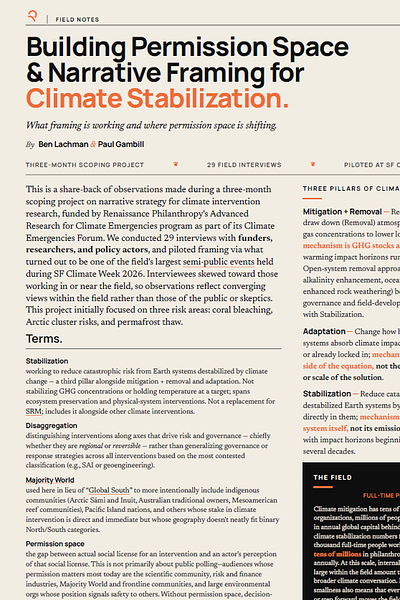
A few illustrative examples of the insights documented in the output include:
How a risk-first framing (leading with tipping point risks, for instance) versus a solutions-first framing (leading with a potential proposed intervention to address the risks in question) can help advance discussions and debates that otherwise become polarized very quickly and stall out as a result.
The importance of disaggregating different interventions: Many strategies differ from one another considerably, whether with respect to their scale, reversibility, the central mechanism of action, etc… This is important because terms like “geoengineering” are often used as a metonym for SAI, even though there are many dozens of diverse intervention strategies with unique characteristics.
Latent support for the field is likely larger than visible support: Many practitioners privately support researching interventions but don’t necessarily make this known publicly, as doing so has historically and may still carry asymmetric career risk.
Another output of this work is that Paul and Ben will continue working with ARC and CEF. Specifically, they will lead the evolution of CEF as an organization to continue growing its capacity to serve as a field-building catalyst for climate stabilization and address the needs identified in the synthesis of their field interviews. More details on the evolution of CEF are forthcoming later this year.
If these topics are interesting and important to you, your organization, and your work, ARC, CEF, and many partner organizations are also gearing up for the first annual Global Risk and Stabilization Summit, which will take place on October 12-13 in Iceland. The Summit is, in many ways, an extension of the work CEF has led since its inception in 2024 (convening practitioners, promoting visibility and collaboration across the field, prompting important debates, discussions, and deliberation).
For more information on the Summit’s goals, topics, and schedule, as well as to apply to attend, please visit at globalstabilization.org. Plus, if you’re generally interested in partnering with CEF on future events, projects, or simply want to connect, please email paul.gambill@renphil.org and/or ben.lachman@renphil.org.